Ontario legal information · Ottawa and Eastern Ontario
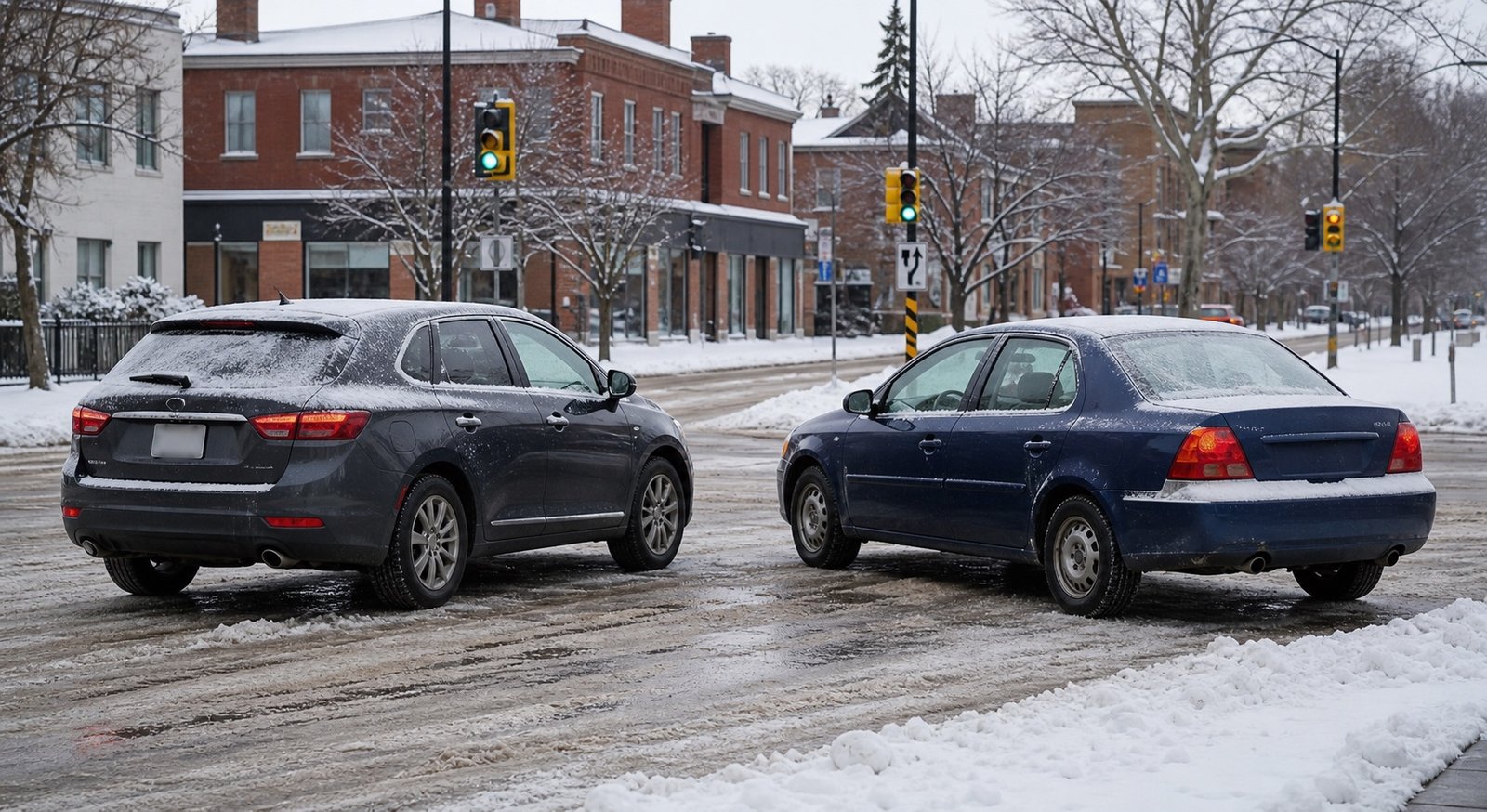
Winter conditions affect the standard of care, not the need for evidence.
Ask when precipitation began, what the driver could see, whether speed and spacing changed, which tires were fitted and how the vehicle responded. Compare that account with weather and roadway records.2
A road-maintenance issue is not automatic. Control, standards, treatment timing, notice and causation require a focused investigation before a municipality or contractor is added.
Driver and roadway questions should be kept distinct.
Driver responsibility
Speed, lookout, braking, following distance and vehicle control remain central.
Road authority
A maintenance claim requires proof under the applicable public-authority framework.
Accident benefits
Eligible benefits can proceed without waiting for the winter-fault investigation.
Preserve evidence that explains the condition and the response.
Record surface, accumulation, temperature, visibility and treatment evidence.
Keep tire type, tread, mechanical and electronic information.
Document lane, speed range, braking, contact and rest positions.
Identify witnesses, dashcam, traffic video and maintenance records.
The best winter evidence can disappear within hours.
Photograph promptly and send targeted preservation requests. Weather records should be tied to the exact location and time.3
Municipal notice and civil limitation issues require separate analysis; neither should wait for the injury to stabilize.
How a personal injury lawyer may help after this collision.
The lawyer's role should be tied to this accident: identify who may be responsible, find every policy that may respond, preserve evidence and build the claim around the person's actual recovery and loss.
- Reconstruct the driver response to winter conditions
- Preserve weather, tire and road-treatment evidence
- Assess public-authority responsibility only where supported
- Coordinate benefit and liability claims
Not every file requires every step or legal representation. The work should respond to the actual dispute, evidence gap or decision that is approaching.
Sources and legal references
These official sources provide the legal and procedural foundation for this page. Their current wording and the facts of the claim control.
View 4 sources
- Ontario — Highway Traffic Act
Ontario road-use, vehicle and reporting duties.
Back to footnote ↑ - Ontario — Fault Determination Rules
Insurance fault rules for common automobile collision configurations.
Back to footnote ↑ - Ontario — Limitations Act, 2002
The basic limitation and discoverability framework.
Back to footnote ↑ - Ontario — Negligence Act
Shared fault and contribution between responsible parties.